
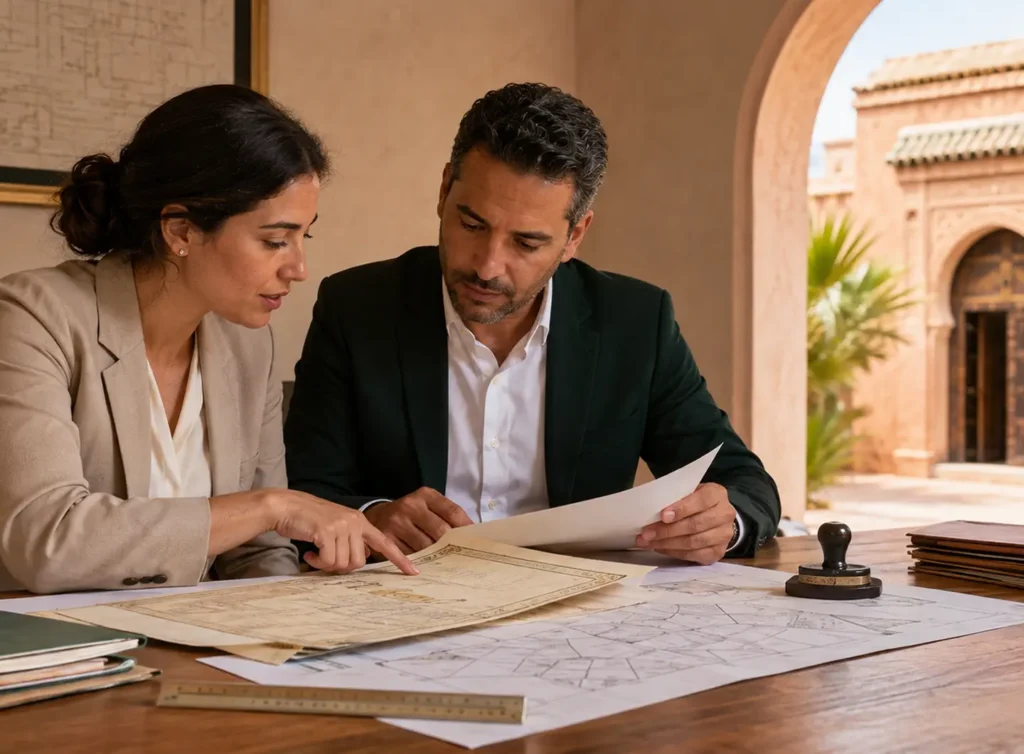
When buying real estate in Morocco, three expressions frequently arise: registered property, property undergoing land registration and melkia property. They do not refer to three equivalent documents, but to three very different legal situations. Confusing them can delay a transaction for months, make financing more difficult or expose the buyer to a dispute over ownership, surface area or property boundaries.
The subject is particularly timely because Law No. 51.26 governing the profession of adouls was published in Official Gazette No. 7533 of 10 August 2026. The law strengthens scrutiny of deeds, professional accountability, digital procedures and the checks required for unregistered property. It is therefore directly relevant to owners and buyers dealing with a melkia, an application for land registration or an adoul deed.
Here is what you need to understand before buying, selling or applying to register a property in Morocco.
Melkia, Pending Registration or Land Title: What Is the Difference?
| Property status | Main document or reference | What it means | Main point to check | |
|---|---|---|---|---|
| Land title and recent certificate of ownership | The property is registered with the Land Registry and the rights affecting it are recorded | Check the entries on the title, the owner’s identity and consistency between the title, the cadastral plan and the property as it physically exists | |
| Land registration application number and registration file | The titling procedure has begun, but a final land title has not yet been created | Check progress, the boundary survey, any objections and whether the supporting documents are sufficient | |
| An adoul deed or a series of adoul deeds relating to unregistered property | Ownership is supported by deeds, the chain of title and, depending on the case, the legal rules governing possession | Audit the chain of ownership, boundaries, rights holders, the land’s legal status and whether registration is genuinely feasible |
A land registration application is not a provisional land title, just as a melkia is not the traditional equivalent of a registered land title. Each stage contributes evidence to the file, but only the successful completion of the land registration procedure results in the creation of a land title.
What Is a Melkia Property in Morocco?
In everyday Moroccan real estate terminology, a melkia generally refers to an adoul deed establishing or tracing ownership of unregistered property. The term is used quite broadly. Depending on the circumstances, the file may rely on a series of sale, partition or inheritance deeds, an old root of title, or a declaration of possession supported by a chahada lafif—collective witness testimony formally received by two adouls.
A melkia may be a substantial legal document, but it does not benefit from the same public registration system as a land title. It is therefore necessary to examine not only the document presented, but also:
- the root of title and continuity of successive transfers;
- the identity and legal capacity of every owner or heir;
- any co-ownership, unsettled estate or power of attorney;
- effective, public, peaceful and continuous possession of the property;
- surface area, boundaries, adjoining owners and any overlaps;
- the land’s legal classification and the applicable planning rules.
Morocco’s Code of Real Rights, in its official French translation published in 2023, states that possession meeting the statutory conditions may establish ownership of unregistered property unless evidence to the contrary is produced. It also states that a deed transferring unregistered property is not, by itself, sufficient proof of ownership: it must be supported by evidence of the root of title and by possession that satisfies the legal requirements.
In other words, a melkia must always be assessed as part of the entire land file. Its date, wording, witnesses, earlier deeds and the reality observed on the ground are just as important as the name of the document.
Can Possession Alone Establish Ownership?
Articles 239 onwards of the Code of Real Rights place strict conditions on acquisitive possession. Among other requirements, the person concerned must exercise effective control over the property, behave as its owner, publicly assert that status, face no challenge and maintain possession for the statutory period.
For a person who is not a co-owner, the reference period is generally ten full years, provided all other conditions are satisfied. Between certain relatives who are not co-owners and where no dispute exists, that period may reach forty years. These time limits must never be considered in isolation from the rest of the legislation: concealed, violent, ambiguous or interrupted possession—or possession based on an origin that cannot transfer ownership—does not have the same legal effect.
The Code also excludes certain property from acquisition through possession, including property in the public or private domain of the State, habous property, land belonging to ethnic communities, property owned by local authorities and property that is already registered.
In addition, a non-Moroccan cannot claim ownership solely through long possession. For a foreign buyer, the root of title, the required form of the deed and, where relevant, the land’s agricultural designation therefore require particularly careful examination.
What Is the Role of an Adoul in a Real Estate File?
An adoul is an officer of the court who practises a regulated liberal profession. Adouls receive and draft deeds and witness statements to which the law requires or permits authentic status to be granted.
In real estate, their intervention is particularly important for unregistered property, property undergoing registration, estates, partitions and certain forms of evidence used to establish ownership. They must check the parties’ identities, status and legal capacity to dispose of the property, as well as the legal conformity of the documents submitted. The new law also imposes a duty to advise the parties about the scope and consequences of the deed.
However, securing a transaction should not be reduced to choosing between an adoul and a notary. Depending on the property and the proposed transaction, the coordinated involvement of an adoul, notary, specialist lawyer, licensed surveyor and the Land Registry may be necessary. The real estate agency prepares and coordinates the transaction, but does not replace any of these legal or technical checks.
What Law No. 51.26 Changes for Melkia Property and Pending Registration Files
Law No. 51.26 was promulgated by Dahir No. 1.26.58 of 28 July 2026 and published in the Official Gazette on 10 August 2026. It is scheduled to enter into force 90 days after publication. The former framework therefore continues to apply during this transitional period. Some mechanisms will also depend on implementing regulations setting out their practical operation.
For private individuals, the most relevant changes are as follows.
Stronger Checks on Identity, Legal Capacity and Documents
Under the adoul deed procedure, the two adouls assigned to receive and draw up the instrument must, under their own responsibility, verify the parties’ identities, status and legal capacity to contract, as well as the legal conformity of the supporting documents. Moroccan law normally requires an adoul deed or testimony to be received by two adouls acting together; an exceptional separate reception may be authorised by the competent judge. The instrument must precisely identify the parties and the property, cite the documents relied upon and record the relevant amounts, surface areas and registration formalities.
This requirement is particularly important when the property belongs to several heirs, a power of attorney is being used, or the root of title depends on several old deeds.
A Specific Check Before Ownership of Unregistered Property Is Established
Article 56 of the new law provides that, when establishing ownership of unregistered property, the adouls must obtain a certificate from the local authority confirming that the property does not belong to an ethnic community, the habous estate or the State. The practical arrangements are to be specified by regulation.
This provision reinforces a fundamental safeguard: long occupation or witness testimony cannot be used to privatise land governed by a special land regime.
More Detailed Rules for Chahada Lafif Testimony
The new law defines chahada lafif as collective testimony concerning facts or rights for which the law does not prescribe another specific form of evidence. In particular, it requires:
at least twelve witnesses;
- full knowledge of the facts being attested;
- detailed and individual examination of every witness by the two adouls;
- precise identification of each witness and the source of their knowledge;
- where the interviews take place on different dates, completion within a maximum period of fifteen days.
For a melkia based on possession, this stricter procedure should improve the traceability of the evidence. However, it does not automatically turn the deed into a land title and does not prevent a challenge during the land registration procedure.
Clarified Territorial Jurisdiction
For unregistered property or property undergoing registration, the new law generally assigns jurisdiction to an adoul whose office is located within the territorial jurisdiction of the Court of Appeal where the property is situated. The rules are more flexible for deeds concerning property that is already registered.
This distinction is practical: it keeps the handling of a melkia or pending registration file close to the authorities, witnesses and physical land concerned.
Mandatory Professional Liability Insurance
The law makes professional civil liability insurance compulsory for adouls. An adoul may also be liable for professional errors committed by employees or trainees under their supervision. The minimum amount of cover is to be set by regulation.
More Digital and Traceable Deeds
The reform progressively organises:
- the use of electronic registers;
- electronic transmission of deeds;
- manual or electronic endorsement by the judge responsible for documentation;
- digital preservation of deeds;
- daily electronic filing of documents on a platform supervised by the Ministry of Justice.
The judge responsible for documentation must review the deed and, in principle, endorse it within a maximum of three days. The deed acquires authentic legal status only after this judicial endorsement, commonly known as khatab or khitab.
Digitalisation should reduce certain risks of loss, improve traceability and facilitate document retention. It does not, however, remove the need to investigate the root of title or pursue the land registration procedure with the National Agency for Land Conservation, Cadastre and Cartography (ANCFCC).
More Frequent Professional Inspections
An adoul’s office must be inspected at least once a year by the judge responsible for documentation. Further reviews and inspections may be carried out by professional bodies, the public prosecutor’s office or the government authority responsible for Justice. Disciplinary penalties can range from a warning to removal from the profession.
What Is a Land Registration Application?
The land registration application—known locally as a réquisition d’immatriculation—is the request that opens the procedure for creating a land title. It may be filed by the owner, a co-owner, certain holders of rights in rem, the legal representative of a minor or legally incapable person and, under certain conditions, a creditor pursuing enforcement against real estate.
The file must contain the deeds and documents disclosing and supporting the right claimed. Once the application has been examined and the applicable fees paid, it is assigned a land registration application number.
That number proves that a procedure is under way. It does not prove that the process will necessarily result in the creation of a land title.
The Steps Required to Register and Title Property in Morocco
The standard procedure described by the National Agency for Land Conservation, Cadastre and Cartography involves several stages.
1. Filing the Application
The applicant files the request with the relevant Land Registry office, together with the documents relating to ownership and after the necessary cadastral identification. The file is examined, approved for processing and formally entered into the register.
2. Publication and Public Display
An extract from the application is published in the Official Gazette and displayed at the relevant Court of First Instance, local authority and municipal council. This publicity allows third parties to learn of the application.
3. Boundary Survey
The boundary survey is simultaneously a topographical operation, a publicity measure and an on-site legal inquiry. It takes place in the presence of the applicant or their representative and any interested parties. A formal report and sketch are prepared.
4. Cadastral Survey and Preparation of the Land Plan
The cadastral survey determines the precise footprint, nature and boundaries of the property. It results in the preparation of the final land plan.
5. Notice of Completion of the Boundary Survey and Objections
Once the plan has been received, a notice announcing completion of the boundary survey is published and displayed. Objections may be filed until the end of a two-month period following publication of this notice in the Official Gazette.
6. Final Cadastral Verification
The cadastral service verifies, in particular, that the property does not overlap with land that is already registered, the public domain, an officially approved administrative boundary or expropriated property.
7. The Registrar’s Decision
There are four main possible outcomes:
registration, with creation of a land title when the file is valid and sufficient and no objection remains;
cancellation of the application, particularly where the applicant fails without justification to attend the boundary survey or does not pursue the procedure after formal notice;
rejection due to an irregularity or insufficient supporting documents;
referral to the Court of First Instance when an objection must be adjudicated.
For a broader overview of legal checks and acquisition procedures, see our English-language guide to buying property in Morocco.
Can You Buy Property While Its Registration Is Pending?
A transaction involving property that is undergoing registration may be considered, but it must be structured according to the actual risk presented by the file. Before making any commitment, the buyer should obtain and analyse:
- a complete copy of the registration application and all deeds filed with it;
- the precise status of the procedure at the Land Registry;
- the boundary survey report and any available plan;
- the notices and publications already completed;
- any objections, overlaps or competing claims;
- the position of heirs, co-owners and other rights holders;
- the applicable planning rules and compliance of any buildings.
The preliminary sale agreement should then include suitable conditions precedent, a realistic timetable and a secure payment mechanism. Depending on the file, it may be prudent to make the release of funds conditional upon creation of the land title or completion of specifically identified formalities.
An attractive price never compensates for an uncertain root of title, a poorly defined parcel or a serious objection.
Essential Checks Before Buying a Melkia Property
Before signing, a buyer should arrange for at least the following points to be checked.
The Complete Chain of Ownership
Earlier instruments must be traced and every transfer verified, whether by sale, gift, partition, inheritance or court judgment. A break in the chain, a missing original or an omitted heir can jeopardise the remainder of the process.
All Owners and Rights Holders
The seller’s identity must correspond with the deeds. Where an estate or co-ownership is involved, every right and ownership share must be determined. The validity and scope of any powers of attorney must also be checked.
The Physical Reality of the Property
An on-site inspection and topographical work are often essential to reconcile the boundaries described in the deeds with actual occupation, neighbouring properties and the measured surface area.
No Incompatible Land Regime
The file must make it possible to rule out land belonging to the State, the habous estate, an ethnic community, the public domain or any other special regime. Searches should also be made for any earlier registration application, expropriation or cadastral overlap.
Planning and Building Status
Ownership of land and the right to build are separate issues. An ownership deed guarantees neither that the land is buildable nor that an existing building is compliant. Authorisations, approved plans, permits, zoning designation and any planning infringements must be checked separately.
Whether Land Registration Is Feasible
Before buying, it is useful to assess the prospects and constraints of a future registration application: the quality of the deeds, availability of witnesses, consistency of the boundaries, risks of objections, administrative documents and the overall cost of technical and legal work.
You can also consult our English-language property buying guide for Morocco and frequently asked questions about buying and owning property.
Is Registered Property Automatically Ready to Sell?
A registered land title is the most secure point of reference, but it is still necessary to obtain a recent certificate of ownership and compare the registered information with the property as it physically exists.
For example, a villa may have been built while the title and cadastral plan still describe vacant land. An extension may not appear on the plan. A mortgage, attachment or easement may also affect the property. Bringing the land plan into conformity with the actual premises may then become a prerequisite for the sale or financing.
These checks form an important part of the due diligence described in our guide to buying property in Morocco.
What the Reform of the Adoul Profession Does Not Change
Law No. 51.26 strengthens professional regulation and the traceability of deeds. It does not, however, eliminate the differences between a melkia, a pending land registration application and a registered land title.
It does not mean:
- that a melkia automatically becomes a registered land title;
- that twelve witness statements alone guarantee the absence of a dispute;
- that a land registration application number guarantees completion of the titling process;
- that digitalisation replaces the boundary survey, statutory publication or objection period;
- that an adoul can certify whether a property is buildable or complies with planning law;
- that a buyer can dispense with an independent legal and topographical audit.
The reform strengthens one essential link in Moroccan property documentation. Final security remains the result of a chain of checks, extending from the root of title through registration of the right to consistency between the documents and the land itself.
Frequently Asked Questions About Melkia Property, Land Registration and Titling in Morocco
What Is the Difference Between a Melkia and a Land Title?
A melkia relates to unregistered property and relies on deeds, the root of title and, depending on the case, possession or witness testimony. A land title is created by the Land Registry at the end of the registration procedure and provides official publication of the rights recorded against the property.
Is a Land Registration Application Definitive Proof of Ownership?
No. It confirms that an application for registration has been filed. The procedure may still be challenged, cancelled, rejected or referred to the courts.
How Many Witnesses Are Required for a Chahada Lafif?
Law No. 51.26 requires at least twelve witnesses, each of whom must be examined individually and in detail by the two adouls. This rule will take effect when the law enters into force and in accordance with the procedures applicable at that time.
Which Adoul May Handle Unregistered Property?
Under the new law, jurisdiction generally belongs to an adoul whose office is within the territorial jurisdiction of the Court of Appeal where the unregistered property, or property undergoing registration, is located.
How Long Does It Take to Obtain a Land Title?
There is no single guaranteed timeframe. The schedule depends on the quality of the file, the boundary survey, preparation of the plan, statutory publications, the workload of the relevant authorities and, above all, whether objections or disputes arise.
Will a Bank Finance a Melkia Property?
Banks determine their own security requirements and generally prefer registered property over which a clear mortgage can be granted. A melkia or pending registration file may therefore make financing more difficult or lead the bank to request additional security.
Can Property Be Sold Before Registration Is Complete?
A transaction can be legally structured before the title is created, but it must never be treated as an ordinary sale of property that is already registered. The deed, conditions precedent, updating of the registration file and release of the purchase funds must be organised with the appropriate professionals.
How Atlasimmobilier Can Help
In Marrakech and Essaouira, the diversity of the property market makes it essential to analyse land status from the very beginning of a sale or property search. A medina riad, suburban villa, rural house or plot of land may have very different legal histories despite appearing physically comparable.
Established in 1999, Atlasimmobilier helps sellers prepare their files and buyers identify the necessary checks, in coordination with adouls, notaries, lawyers, surveyors and the competent public authorities. This preparation helps avoid unnecessary viewings, premature commitments and last-minute obstacles at the signing stage.
Are you planning to buy or sell a melkia property, or do you need to clarify the status of a property undergoing registration? Contact Atlasimmobilier to arrange an initial review of your project.
Sources and Update Information
Article updated on 26 August 2026.
This article provides general information only and is not a substitute for legal advice based on the documents and individual circumstances of the property concerned.